Latest Movie :
Recent Movies

Blue Origin completes engine test

Blue Origin completes engine test  Another commercial spaceflight venture has taken a step forward. Early this month, aerospace firm Blue Origin successful test fired its 100,000 lb (444,840 N) thrust BE-3 liquid hydrogen/liquid oxygen engine thrust chamber. The full-power static fire test took place at the E-1 test stand at NASA's Stennis Space Center near Bay Saint Louis, Mississippi and is part of Blue Origin’s program to develop a launch system for its manned Space Vehicle.

Blue Origin completes engine test

Blue Origin completes engine test

Blue Origin completes engine test

Blue Origin completes engine test

Blue Origin completes engine test
 Artist's concept of the Blue Origin crew capsule (Image: Blue Origin)
    Blue Origin's orbital Reusable Booster System (Image: Blue Origin)
    An early prototype of Blue Origin's New Shephard vehicle (Image: Blue Origin)

Set up by Amazon.com founder Jeff Bezos, Blue Origin is working on a number of space projects, most notably its Shepard suborbital spacecraft. The BE-3 engine is part of Blue Origin’s Reusable Booster System (RBS), which will be used to boost the biconic-shaped Space Vehicle, which the company is also developing. The Space Vehicle and booster are part of NASA's Commercial Crew Program (CCP) intended to spur development of American manned commercial space vehicles for hire by NASA and private customers.
Artist's concept of the Blue Origin crew capsule (Image: Blue Origin)

Artist's concept of the Blue Origin crew capsule (Image: Blue Origin)

Blue Origin is conducting the engine test under a US$22 million dollar contract for the Commercial Crew Development Round 2 (CCDev2). As part of CCDev2, the Federal Aviation Administration and the company carried out an assessment and review of the Space Vehicle to determine if the spacecraft meets safety and mission requirements for low-Earth orbit flight. This review includes over 100 wind tunnels tests as well as assessments of the vehicle's aerodynamic design and flight and cross-range maneuverability.

Source: NASA

U.S. Air Force goes vortex surfing to cut fuel consumption

U.S. Air Force goes vortex surfing to cut fuel consumption The United States Air Force (USAF) is taking flying lessons from geese and spiny lobsters. This may seem like the mother of all bureaucratic errors, but there’s actually some pretty solid science behind it. In exploiting a phenomenon known as “vortex surfing,” the USAF has found that by having C-17 cargo planes flying in formation, it can reduce fuel consumption by up to ten percent.

U.S. Air Force goes vortex surfing to cut fuel consumption

 U.S. Air Force goes vortex surfing to cut fuel consumption
U.S. Air Force goes vortex surfing to cut fuel consumption

U.S. Air Force goes vortex surfing to cut fuel consumption

U.S. Air Force goes vortex surfing to cut fuel consumption

U.S. Air Force goes vortex surfing to cut fuel consumption

U.S. Air Force goes vortex surfing to cut fuel consumption

U.S. Air Force goes vortex surfing to cut fuel consumption

U.S. Air Force goes vortex surfing to cut fuel consumption

Tw0 C-17 cargo planes used in the $AVE vortex surfing tests (Image: US Air Force)
C-17 generating vortices in smoke trails of flares (Image: US Air Force/Tech. Sergeant Rus...
Migrating geese use vortex surfing (Image: John Benson)
 US Navy FA-18C creating vortices at the wingtips (Image: US Navy)
View all
Vortex surfing involves the whirlwinds of turbulence generated at the wingtips of planes in flight. Because they produce turbulence and drag, aeronautical engineers do their best to minimize these. That’s the reason for the little winglets on aircraft. Now, instead of trying to get rid of vortices, the USAF is trying to exploit them to increase fuel economy.
Tw0 C-17 cargo planes used in the $AVE vortex surfing tests (Image: US Air Force)

This may be cutting edge as far as aviation is concerned, but vortex surfing has been around a long time. In fact, nature has been exploiting it for millions of years. Geese flying in formation vortex surf. The lead bird generates vortices as it flies and the other geese position themselves inside the wave of turbulence also known as a slipstream. Though the lead bird is working hard, the vortices it generates increase lift for the following birds. The lead bird has to work harder, but the net energy savings for the flock as a whole goes down.

Lobsters use vortex surfing, too. Spiny lobsters migrate in long queues called “lobster quadrilles” where the principle is the same as with the geese. The lead lobster pushes through the water, stirring up vortices, and the others line up behind to take advantage of the slipstream for an easier march.
Migrating geese use vortex surfing (Image: John Benson)

Airbus has also proposed flying commercial aircraft in formation in “express skyways” to reduce fuel consumption as part of its “Smarter Skies” initiative that looks to the future of air travel. Now the USAF sees it as a way of decreasing fuel consumption over long-haul cargo flights.

As part of a program called Surfing Aircraft Vortices for Energy, or $AVE, the Air Force carried out tests in September and October at Edwards Air Force Base in California. Two C-17 Globemaster III cargo jets were used to see if what works for a goose will work for a plane big enough to carry an M1 battle tank. The tests involved two aircraft – one flying ahead while the other surfed on the vortex of the leader to gain updraft without expending additional fuel.
C-17 generating vortices in smoke trails of flares (Image: US Air Force/Tech. Sergeant Rus...

Unfortunately, vortex surfing involves more than just clever flying. To carry out the maneuver, the C-17’s autopilot software had to be modified to allow the aircraft to remain in the proper formation on the vortex without pilot assistance.

"The autopilot held the position extremely well – even close to the vortex," said Capt. Zachary Schaffer, commander on one of the test flights. "The flight conditions were very safe; this was as hands-off as any current formation flying we do."

The early tests showed a ten percent fuel savings over the course of the flights. The Air Force said its Air Mobility Command (AMD) conducts 80,000 flights per year, so a ten percent reduction in fuel consumption would translate into millions of dollars in savings. The Air Force Research Laboratory is now analyzing the test data and plans to adapt vortex surfing for other aircraft and missions.

Source: USAF via Dvice

First in-flight weapons release for F-35A

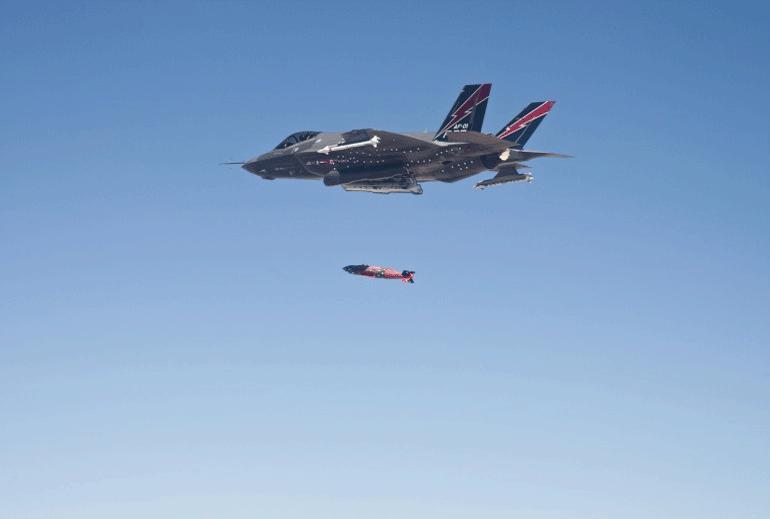
First in-flight weapons release for F-35A  After strapping on its missiles in February shortly after its first night flight, the conventional takeoff and landing (CTOL) version of the Joint Strike Fighter, the F-35A, completed its first in-flight weapons release on October 16 in a flight conducted over the China Lake test range in California.

First in-flight weapons release for F-35A 

First in-flight weapons release for F-35A

First in-flight weapons release for F-35A

First in-flight weapons release for F-35A

First in-flight weapons release for F-35A
The first in-flight weapons release for the F-35A took place over the China Lake test rang... The first in-flight weapons release for the F-35A
The F-35A was piloted by U.S. Air Force Major Eric “Doc” Shultz
The flight piloted by U.S. Air Force Major Eric “Doc” Shultz, saw a 2,000 pound (907 kg) instrumented GBU-31 BLU-109 Joint Direct Attack Munition (JDAM) jettisoned from the left internal weapons bay of the 5th Generation F-35A fighter known as AF-1.
To maximize its stealth capabilities, the F-35A features four internal weapons stations located in two weapons bays, but also boasts three external weapons stations per wing for a total of 10 weapons stations that are designed to allow the aircraft to carry a payload of up to 18,000 pounds (8,165 kg).
The F-35A is the smallest and lightest F-35 variant and is intended for use by the U.S and other air forces.
Source: Lockheed Martin

First in-flight weapons release for F-35A

CHEOPS, the first ESA “small mission,” will study super-Earths

CHEOPS, the first ESA “small mission,” will study super-Earths The European Space Agency (ESA) is set to give existing orbiting probes, such as COROT and Kepler, a helping hand in studying super-Earths. Selected from 26 proposals, the CHEOPS (CHaracterising ExOPlanets Satellite) spacecraft is the first S-class (“small”) mission in the ESA’s Science Programme. A partnership between the ESA and the Swiss Space Office, CHEOPS will not seek out new exoplanets, but will instead target nearby, bright stars that are already known to have orbiting planets.

CHEOPS, the first ESA “small mission,” will study super-Earths

CHEOPS, the first ESA “small mission,” will study super-Earths

CHEOPS, the first ESA “small mission,” will study super-Earths

CHEOPS, the first ESA “small mission,” will study super-Earths
Slated for a 2017 launch, CHEOPS will operate in a Sun-synchronous low-Earth orbit at an altitude of 800 km (497 miles). To give an accurate measurement of the radius of an exoplanet under study, the spacecraft will use the transit method that observes the drop in brightness of the star that occurs when a planet crosses (transits) in front of it. The density of planets with a known mass can also be calculated, providing an indication of the planet’s internal structure.
CHEOPS will use the transit method to measure the radii of exoplanets (Image: CNES)

This information will help shed light on the formation of planets ranging from super-Earths with a mass a few times that of Earth, up to Neptune-sized worlds. The spacecraft will also be used to identify planets with significant atmospheres and will be used to highlight targets for more detailed studies of exoplanet atmospheres by the next generation of telescopes in the pipeline, such as the ground-based European Extremely Large Telescope and the James Webb Space Telescope.

“By concentrating on specific known exoplanet host stars, CHEOPS will enable scientists to conduct comparative studies of planets down to the mass of Earth with a precision that simply cannot be achieved from the ground,” said Professor Alvaro Giménez-Cañete, ESA Director of Science and Robotic Exploration.

The video animation below shows how CHEOPS will operate.

Source: ESA

Blue Origin tests its pad escape system

Blue Origin tests its pad escape system  Aerospace firm Blue Origin has already conducted wind tunnel and engine tests, in the development of its reusable orbital Space Vehicle. Last week, however, the company took a step forward in the development of its New Shepard suborbital system – at its West Texas launch site, the company conducted a successful pad escape test, in which a full-scale crew capsule was ejected from a launch vehicle simulator.

Blue Origin tests its pad escape system

Blue Origin tests its pad escape system

Blue Origin tests its pad escape system

Blue Origin tests its pad escape system
An actual pad escape would be necessary if there were an emergency upon launch, and the three-person crew (within their capsule) had to separate from the launch vehicle. SpaceX has also addressed this scenario, with tests of its SuperDraco engine-equipped crew capsule.

Blue Origin’s capsule broke free of the launch vehicle simulator thanks to its integrated pusher escape motor, which launched it to an altitude of 2,307 feet (703 meters) under active thrust vector control. It subsequently descended by parachute, making a soft landing 1,630 feet (497 meters) downwind from the launch site.
The crew capsule parachutes back to the ground

Although the exercise was conducted with the New Shepard in mind, Blue Origin has stated that results of the test will also inform the design for the escape system of the Space Vehicle. A NASA-posted video of the test can be seen below.

Source: Blue Origin via PopSci

Sunseeker team building a two-passenger solar-powered airplane

Sunseeker team building a two-passenger solar-powered airplane  The unofficial human-powered helicopter flight record set by Kyle Gluesenkamp from the A. James Clark School of Engineering's Gamera II team on June 21 2012 has just been ratified by the National Aeronautic Association (NAA). The new national record has now been submitted to the Fédération Aéronautique Internationale for approval as a new world record.

Sunseeker team building a two-passenger solar-powered airplane

 Sunseeker team building a two-passenger solar-powered airplane
Sunseeker team building a two-passenger solar-powered airplane

Sunseeker team building a two-passenger solar-powered airplane

Sunseeker team building a two-passenger solar-powered airplane

Sunseeker team building a two-passenger solar-powered airplane

Sunseeker team building a two-passenger solar-powered airplane

Sunseeker team building a two-passenger solar-powered airplane

Sunseeker team building a two-passenger solar-powered airplane

Sunseeker team building a two-passenger solar-powered airplane

Sunseeker team building a two-passenger solar-powered airplane

Sunseeker team building a two-passenger solar-powered airplane

Sunseeker team building a two-passenger solar-powered airplane

Sunseeker team building a two-passenger solar-powered airplane

Sunseeker team building a two-passenger solar-powered airplane

Sunseeker team building a two-passenger solar-powered airplane

Sunseeker team building a two-passenger solar-powered airplane

Sunseeker team building a two-passenger solar-powered airplane

Sunseeker team building a two-passenger solar-powered airplane
Piloted solar flight has been a reality for some time, with even international flights now possible. Up to this point, such voyages have been a strictly solo affair, however the team originally responsible for the Sunseeker II intends to change this by manufacturing what’s billed as the world’s first two-seater solar aircraft – a motor glider named the Sunseeker Duo.

    The Sunseeker Duo is a work-in-progress, and in order to help bring the project to complet...
    The Sunseeker Duo sports a wingspan of 23 meters (75 feet)
    The propeller will be driven by a 20 kW direct drive motor, with power deriving from 72 li...
    The Sunseeker Duo aims to reduce the weight of the Stemme S-10 from its standard empty wei...
    View all

The design of the Sunseeker Duo is based upon the Stemme S-10, a glider which has been in production since the 1980’s and features a folding propellor which is contained within the aircraft’s nose cone when not in use. The Sunseeker Duo maintains this design, though does so while aiming to reduce the weight of the Stemme S-10 from its standard empty weight of 645 kg (1,422 pounds), to 270 kg (595 pounds).
The propeller will be driven by a 20 kW direct drive motor, with power deriving from 72 li...

The Sunseeker Duo sports a wingspan of 23 meters (75 feet) and the propeller will be driven by a 20 kW direct drive motor, with power provided by 72 lithium-polymer batteries, wired in series. Those batteries are said to store enough power to allow 20 minutes of full-power climbing, and following this, the pilot may glide while they charge. When above the clouds, the Sunseeker Duo will have the capacity to cruise on direct solar power for hours.

At present, the Sunseeker Duo is still a work-in-progress, and in order to help bring the project to completion, the Sunseeker team has turned to Kickstarter to raise funds. If all goes to plan, project leader Eric Raymond aims to make a series of flights worldwide, beginning with a circumnavigation of the Americas, with the goal of highlighting the benefits of solar technology.

In addition, a documentary film crew will follow the progress of Raymond, and a book is also planned to document the adventure.

The video below features the team's pitch.

Source: Kickstarter

NASA heli-capsule could let astronauts land anywhere

NASA heli-capsule could let astronauts land anywhere  Space exploration once captured the world's imagination. In the 1960s and 1970s, children dreamed of satellites, lunar rovers, and walking on the moon. Today – decades after Sputnik, Neil Armstrong, and the Apollo missions – many children may not even know what a space capsule is.

NASA heli-capsule could let astronauts land anywhere

NASA heli-capsule could let astronauts land anywhere

NASA heli-capsule could let astronauts land anywhere

NASA heli-capsule could let astronauts land anywhere
Some of those children from the Space Race years, though, grew up to work at NASA. Public indifference be damned, those engineers are still dreaming of new ways of improving the wondrous technologies of yesteryear. If they have their way, one of the iconic symbols of that era – the space capsule – may have an upgrade on the horizon.
Rekindling an old idea
This model may help the researchers figure out how to use wind-powered propellors (Photo: ...

This model may help the researchers figure out how to use wind-powered propellors (Photo: NASA)

Researchers at NASA's Kennedy Space Center in Florida are testing a rotor system that would let space capsules fly like helicopters. Originally proposed during the Apollo days, the idea had been abandoned in favor of easier (and cheaper) parachutes. The downside of parachutes, though, is that they require a water landing. So, today's NASA is reinvestigating.

A heli-capsule could land gently, and nearly anywhere. Imagine astronauts returning from a mission, guiding their capsule onto the roof of an office high-rise. Or perhaps they would softly land their vessel in a rural field. This level of control would provide a wider array of options for re-entry and landing.

The helicopter-like design wouldn't, however, be powered by an engine. The researchers are looking for ways to activate the capsule's blades without using any power. The idea is to use wind to activate the propellors – a concept that NASA says has been used in helicopters, but never in spacecrafts.

An engineer at Kennedy, Les Boatright, likens the project to modern mobile devices:

    "A hundred years ago, there were cameras and there were phones and there were wireless devices to send Morse code and they were all separate technologies on their own. Now you have a telephone that does all three of those things and it's a merger of technology. Well, this is taking the capsule entry technology and helicopter rotor technology and merging those in an innovative way to make something that didn’t exist before out of two things that did exist before."

Early stages
NASA engineer Jeff Hagen prepares a model capsule for testing (Photo: NASA)

NASA engineer Jeff Hagen prepares a model capsule for testing (Photo: NASA)

The helicopter/capsule project is still in the early planning stages, so any real-world implementation could be years away. The next stage would be dropping one of the capsules from a high-altitude balloon (perhaps they could ask Felix Baumgartner). It may then be used for retrieving samples from the International Space Station before being added to bigger space missions.

A heli-capsule may not be enough to get a new generation of children dreaming about space, but it could make return landings a bit safer for some of those children of the 60s and 70s. You can read more on the project at the primary source below.

Source: NASA via Dvice
 
Support : Creating Website | Johny Template | Mas Template
Copyright © 2011. Gizmag | New and Emerging Technology News - All Rights Reserved
Template Created by Creating Website Published by Mas Template
Proudly powered by Blogger